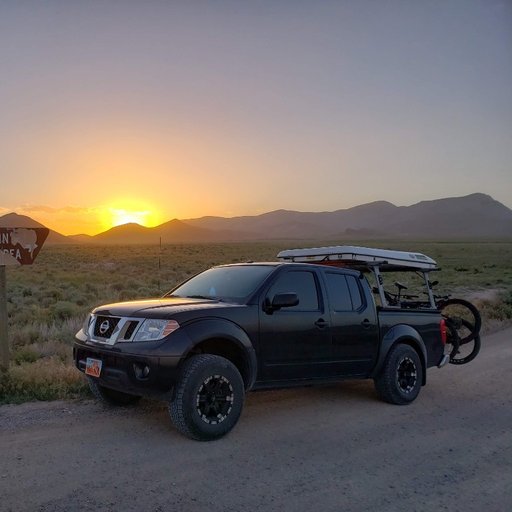
Ground Clearance vs. 4WD: What Actually Stops You?
Search “ground clearance vs 4WD for overlanding” and you get two camps: clearance zealots and drivetrain maximalists. Physics is simpler—geometry limits where the chassis can go; drivetrain limits how much torque reaches the ground once you are there.
On maintained forest service roads, the gate question is rarely “do forest service roads require 4WD?”—most are graded for agency trucks and passenger traffic when dry. What stops stock crossovers is approach and departure angles, not missing a front driveshaft. A 2WD truck with 9″+ clearance and all-terrain tires transits dry BLM two-tracks that would high-center a lowered AWD wagon.
What actually stops you first
Run this checklist before blaming drivetrain:
- Breakover angle — will the belly or diff catch on a berm or rock step?
- Departure angle — will the hitch or spare drag climbing out of a wash?
- Tire construction — passenger all-seasons cut sidewalls on sharp volcanic rock; all-terrain casings survive.
- Loaded ride height — RTT, drawer, and full water tank squat the rear; clearance on paper is not clearance at camp weight.
Overlanding in a 2WD truck or SUV
Overlanding in a 2WD truck / SUV is viable when your route set stays on dry, maintained dirt with escape routes to pavement. Mid-size 2WD pickups (RWD) carry bed load well but bias weight to the rear axle—exactly where you want traction on climbs. 2WD SUVs with part-time 4WD missing are less common in the U.S. but appear in budget builds; front-heavy nose weight helps climbing until the surface turns loose.
AWD crossovers blur the line—they send torque forward under slip but lack low-range reduction. They behave like aggressive 2WD on long desert grades: fine until spin, then heat and trenching.
Ground clearance vs 4WD — what stops you first?
Neither 2WD nor 4WD fixes high-centering; both need line choice and clearance.
| Limiter | Stops 2WD? | Stops 4WD? | Mitigation |
|---|---|---|---|
| High-center on a berm | Yes — scrapes belly or diffs | Yes — same geometry | Line choice, spotter, skid plates |
| Steep loose climb | Often — single driven axle spins | Sometimes — splits torque front/rear | Momentum (2WD) or low-range crawl (4WD) |
| Clay mud after rain | Usually — rear digs a trench | Often — still bogs if all wheels slip | Turn around; boards; winch from rated point |
| Maintained FS road (dry) | Rarely if clearance OK | Rarely | Correct tire pressure; slow for washboards |
The Physics of Traction: Where 2WD Fails
Four-wheel drive does not create traction—it distributes engine torque across more tires so a single spinning wheel does not absorb 100% of power. An open-differential 2WD truck sends power to the path of least resistance, which on loose surfaces is always the spinning tire.
Loose sand and long beaches
Sand demands flotation and steady torque, not bursts of throttle. A 2WD rig without lowered tire pressure relies on momentum—which works until you stop on an uphill or soft patch. Then the rear digs a hole faster than you can reverse out.
This is where all terrain tires vs 4WD debates get practical: a quality AT on a 2WD truck at 18–20 psi survives many Mojave playa crossings that stock highway tires cannot. It still loses to 4WD with matching tires when you must restart mid-dune.
Mud, clay, and the weather pivot
The weather pivot catches 2WD owners more often than missing lockers. A dry, easy dirt road you drove outbound at noon can become impassable clay after a 20-minute monsoon cell. Clay packs into tire lugs, lifts the axle onto a slick pedestal, and turns a 2WD rear end into a high-speed auger.
4WD does not immunize you—mud still wins—but it buys time to back down before the trench is two feet deep. A 2WD truck in the same trap often needs a convoy snatch and leaves a rut that holds water for weeks.
Steep inclines and trail damage from wheel spin
Without low-range crawling, 2WD drivers default to momentum and throttle. On loose volcanic gravel or alpine scree, that translates directly to trail damage from 2WD wheel spin: tossed rocks, widened corners, and braided bypass tracks when the next vehicle avoids your trench.
Low-range 4WD (or a manual transfer case) lets you climb at walking speed with minimal spin—Leave No Trace mechanics, not just etiquette. Open-diff 4WD still spins one wheel per axle; a rear locker on 2WD can outperform it on a straight climb but cannot pull the nose through a loose off-camber corner the way front-axle torque does.
Group dynamics and convoy liability
Remote overlanding rarely happens solo. Bringing an under-equipped 2WD vehicle into a convoy without rated recovery points, boards, and a comms plan makes your rig everyone’s problem. Snatch straps attached to bumper holes bend sheet metal; uncontrolled kinetic recoveries break shackles.
Experienced groups assign weakest-link routing—the 2WD rig runs dry-season spurs only, carries essential 2wd recovery gear, and never leads into unknown mud. If you cannot accept that role, the honest answer to “do you need a 4x4 to start overlanding?” is yes—for your chosen friends and routes.
Where 2WD fails — terrain, spin, and 4WD advantage
Wheel-spin risk is a trail-ethics variable, not just a stuck variable.
| Terrain | 2WD failure mode | Wheel-spin / erosion | 4WD advantage |
|---|---|---|---|
| Loose sand / beach | Rear wheels dig; open diff sends power to spinning tire | High — trenching and erosion | Front axle shares load; low range reduces spin |
| Clay / mud | Single-axle weight bias; no front pull | Very high — ruts deepen for everyone | Four contact patches; locker trims spin |
| Steep loose grade | Momentum-only approach in 2WD tears surface | High on ascent; brake fade on descent | Engine braking in low range; crawl speed |
| Wet cobble / shelf road | Traction loss on driven axle mid-corner | Moderate — slide toward edge | Pull from both axles stabilizes line |
How to Overland Successfully Without 4x4
Overlanding without 4x4 is a route-and-gear strategy, not a badge. You are choosing to stay inside a traction envelope and investing in tools that extend it slightly—never pretending a 2WD open-diff truck is a Rubicon on wet clay.
High-ROI upgrades (in order)
- All-terrain tires sized for your daily commute tolerance—biggest single traction gain per dollar.
- Air compressor + deflator—sand and washboard control lives in pressure, not horsepower.
- Traction boards—self-extraction when one axle spins; pair with a shovel.
- Rated recovery strap, shackles, and frame-mounted points—convoy extraction without bumper damage.
- Rear locking differential—overlanding with 2wd and rear locker closes the gap on straight climbs; still no front pull.
What not to buy first
Skip lift kits before tires. Skip winches before recovery points. Skip Instagram roof loads before you weigh the rig. A 2WD platform already sacrifices traction—adding mass on the roof hurts both balance and fuel range on long dirt legs.
Route discipline
Build a turn-around rule: if surface color shifts to grey clay, if rain is within 30 miles on radar, or if spin exceeds one tire rotation without forward motion—stop and reverse while you still can. 4WD owners who ignore this still get stuck; 2WD owners who ignore it guarantee it.
2WD upgrade ROI — all terrain tires vs 4WD
Cost bands are typical shop ranges—confirm tire size and locker options before you budget.
| Upgrade | Cost band | Traction gain | Replaces 4WD? |
|---|---|---|---|
| All-terrain tires (E or C load) | $800–$1,400 | Large on gravel, wet rock, hardpack | Partial — not in deep sand or clay |
| Traction boards (pair) | $60–$120 | Exit tool when one axle spins | No — recovery, not prevention |
| Rated recovery strap + shackles | $80–$150 | Convoy extraction only | No — requires anchor vehicle |
| Rear locking differential | $400–$1,200 installed | Both rear tires pull on climbs | Partial — still no front axle |
| Factory recovery points / frame hooks | $100–$400 | Safe snatch geometry | No — ethics and safety |
Essential 2WD recovery gear
Weights from our gear-list model—verify your kit on a scale.
| Item | Editorial weight | Role |
|---|---|---|
| Traction boards (2) | ~17 lb | Self-extraction when wheels spin |
| Recovery strap + rated shackles | ~12 lb | Snatch from convoy partner |
| Shovel | ~5 lb | Clear trench; pad boards under tires |
| Air compressor + deflator | ~19 lb | Lower pressure for flotation on sand |
| Tire repair kit | ~3 lb | Sidewall punctures far from pavement |
| Rated front/rear recovery points | — | Avoid bumper/snatch-strap damage |
The risk management framework for beginners
Use this framework before your first multi-day trip—not after you are axle-deep in a group chat screenshot.
- Define your envelope — dry maintained roads only, or seasonal mud/sand? Be honest.
- Match tires to envelope — all-terrain minimum; mud-terrain only if you accept noise and still lack 4WD.
- Carry essential 2wd recovery gear — boards, strap, shovel, points; know how to use them.
- Plan weather exits — pavement distance, cell gaps, alternate routes off ridge lines.
- Convoy contract — who leads, who carries the snatch kit, and whether your 2WD rig accepts rear position only.
- Upgrade path — if two trips end in extraction, stop modding the wrong platform; shop 4WD or AWD with low range.
Bottom line: You can start overlanding without 4x4 on the right routes with the right tires and recovery basics. You cannot ethically or safely pretend 2WD equals 4WD on steep, wet, or loose terrain—trail damage from 2wd wheel spin and convoy liability are the hidden costs forum builds omit. Buy capability that matches your actual map, or buy a different map.
FAQ
Do you need a 4x4 to start overlanding? Not if your first trips stay on dry, maintained dirt with pavement bail-outs—but plan for extraction gear and accept convoy constraints. Serious mud, sand, and alpine routes assume 4WD or AWD with low range.
Do forest service roads require 4WD? Most do not when dry and maintained; seasonal closures and storm damage change that overnight. Check MVUM maps and ranger conditions—drivetrain is not on the sign, mud depth is.
Can all-terrain tires replace 4WD? They improve grip on hardpack, gravel, and wet rock but cannot add a front axle or low-range crawl. They are the first mod on any platform, 2WD or 4WD.
Is overlanding with 2wd and rear locker enough? A rear locker helps straight climbs more than open-diff 4WD; it does not help front-axle pull, descents, or side-hill stability. Pair with AT tires and strict route choice.
What is essential 2wd recovery gear? Traction boards, rated strap and shackles, shovel, compressor/deflator, tire repair, and frame-mounted recovery points—not bumper loops.
Does 2WD damage trails more? High wheel-spin from momentum driving erodes soft surfaces and braids corners. Low-range 4WD at crawl speed minimizes spin; responsible 2WD drivers use the same discipline or stay off sensitive routes.
Read next


 Index
Index