Nissan
Nissan Xterra (1st gen / WD22, 2000–2004)
$4k – $11k typical used · mileage varies. Specs below cite factory payload, clearance, and cargo where available; remaining-payload after occupants and gear is our editorial load model. Trims vary — verify on the sticker, placard, and with Nissan before you load up or buy.
Compare note
Discontinued — used market compare only.
- Reliability vibe
- 7/10
- Ground clearance
- 9.2″ rep.
- Payload (approx.)
- 1,100 lb rep.
- Cargo (approx.)
- 65 cu ft
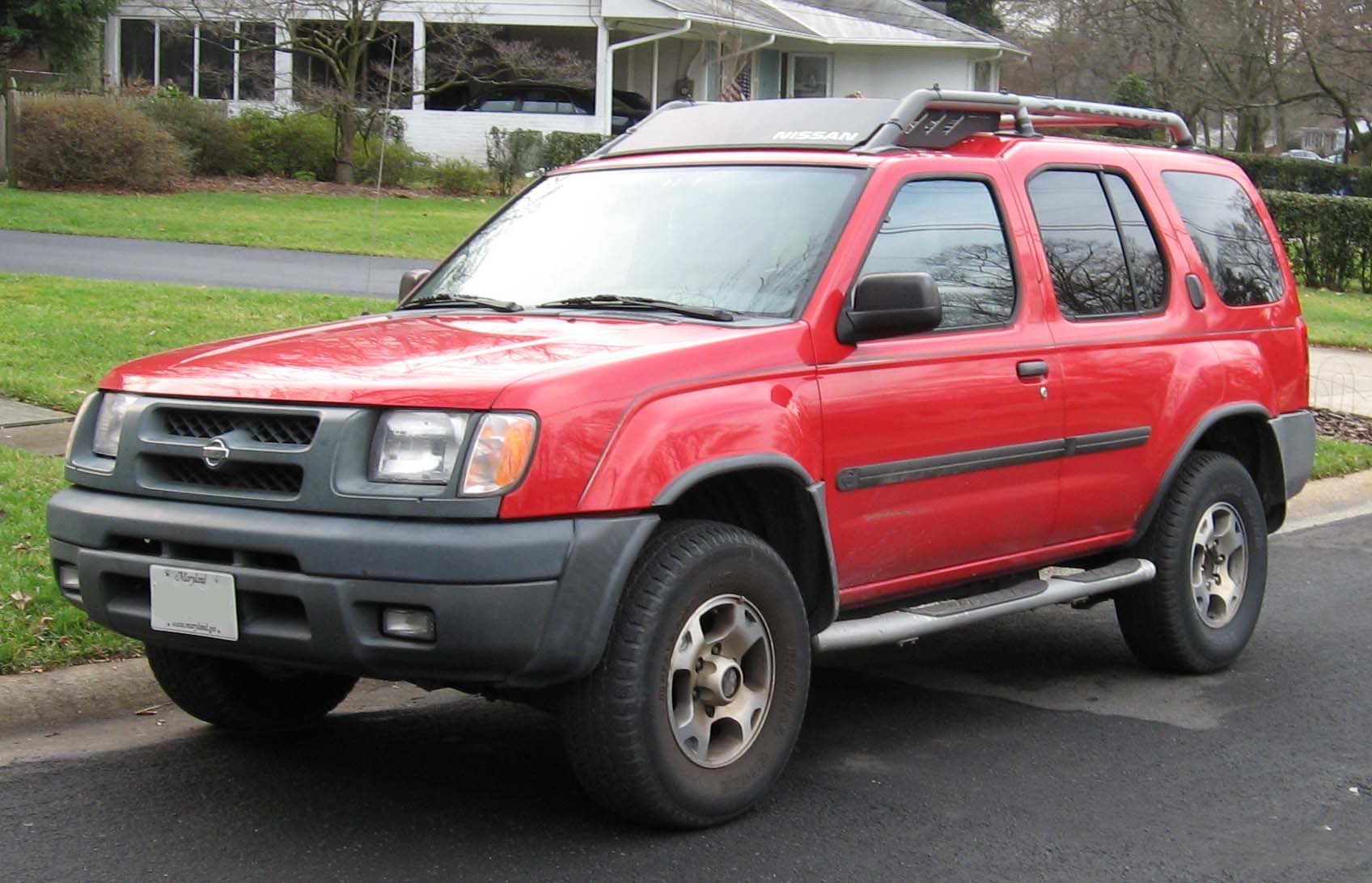
Is the 1st gen Xterra good for overlanding?
Yes — the cheap body-on-frame SUV entry when rust and timing-chain history are honest. It is not Pro-4X locker hardware, modern safety, or family 4Runner space.
Part-time 4WD, low range, simple V6 wrench-it ethos, and folded-seat cargo swallow tiered camp kits on a shoestring. Budget ~1,100 lb payload math, discontinued trim-specific parts hunts, and highway NVH that feels its age before you plan remote travel.
Quick reality check
Heard this claim?
“The WD22 Xterra is too old and rusty to overland.”
Partly true on neglected examples — not equal on budget entry, roof-rack culture, or simple V6 wrenchability on maintained rigs.
WD22 is a 2000s platform — rust and timing-chain homework are real on northern and high-mileage examples. Well-maintained rigs still run graded dirt to camp at a fraction of new-truck pricing. No factory locker or modern ADAS — budget capability per dollar, not flagship confidence. Pick WD22 for cheapest Nissan 4×4 SUV entry; pick N50 Pro-4X for locker hardware — or step to Frontier when you need truck bed utility.
Payload & trail loading
Editorial ballparks for Nissan Xterra (1st gen / WD22, 2000–2004): empty-truck catalog numbers versus two common overlanding load profiles (two occupants assumed). This is the loaded-reality math factory spec sheets skip.
| Spec Category | Stock Factory Specs | With Mid-Weight Build (RTT + Fridge) | With Heavy Build (Armor + Winch) |
|---|---|---|---|
| Total Gear Weight Penalty | 0 lb | 550 lb | 900 lb |
| Remaining Safe Payload | 800 lb | 250 lb | -100 lbBelow safe threshold |
| Real Ground Clearance | 9.25″ | 8.5″ | 7.7″ |
| Free Cargo Space Volume | 65 cu ft | 32.5 cu ft | 19.5 cu ft |
Why this matters: Car dealerships list specs based on an empty truck. Once you add common adventure gear, your legal weight ceiling disappears fast. Always verify your specific door placard math before buying accessories.
Payload degradation
Estimates — verify on your door placard. Occupant weight included from Stage 1 build rows onward (300 lb editorial baseline for two adults).
Payload reality check: factory ~1,100 lb payload is the tightest in our Nissan catalog — Stage 2 RTT builds need CAT scale discipline. ~65 cu ft cargo helps enclosed packing; roof load is not unlimited.
Off-road capability
The first-gen Nissan Xterra (WD22, 2000–2004) is a compact body-on-frame SUV with 3.3L V6, part-time 4WD, low range, and factory roof-rack rails. It excels on budget graded forest roads and weekend dirt-to-camp — not because it out-payloads modern trucks, but because it packages enclosed cargo and 4×4 in a cheap, wrench-friendly envelope.
| Capability | This rig | Notes |
|---|---|---|
| 4WD system | Part-time 4WD | 2WD default — shift 4Hi/4Lo on 4×4 models |
| Transfer case / low range | Yes — 4Lo on 4×4 | Two-speed transfer case — verify 4×4 on listing |
| Center differential | None (part-time) | 4Hi locks front and rear — not a center LSD |
| Front locker | None factory | Aftermarket possible — rare on budget builds |
| Rear locker | None factory | No Pro-4X trim on WD22 — brake traction only |
| Axle layout | IFS front + solid rear | Typical compact SUV layout |
| Traction aids | Limited-slip + brake traction | No factory crawl hardware |
| Stock clearance | ~9.2 in (editorial) | Larger A/T tires help effective trail height |
| Factory skid protection | Minimal | Plan aftermarket skids for rock |
Trail size
Compact SUV footprint — nimbler than full-size trucks on tight spurs, smaller than second-gen N50 in cargo and rear seat. Short wheelbase helps switchbacks; roof-rack height matters on garage and brush.
| Dimension | This rig | Notes |
|---|---|---|
| Width (body) | ~70 in | Compact — mirrors add more |
| Wheelbase | ~104 in | Short — tight switchback friendly |
| Length (overall) | ~178 in | Compact SUV — easier camp parking |
| Turning radius (approx.) | ~18 ft | Nimble for SUV — still plan 3-point turns |
| Approach angle (stock) | ~30° | Base bumper — tire size matters |
| Departure angle (stock) | ~22° | Spare under tailgate — watch ledge exits |
| Breakover angle (stock) | ~22° | Short wheelbase helps vs long trucks |
Shelf roads: Comfortable on maintained forest roads and budget BLM camp runs — compact width is the WD22 advantage. Technical rock and deep snow demand tires and driver skill without factory lockers. N50 Pro-4X is the upgrade path for mechanical crawl hardware.
Where it fits
Graded Forest Service / county dirt roads
ComfortableDefault WD22 playground — budget tire upgrade helps.
Narrow shelf roads & one-lane spurs
ComfortableCompact width — easier than full-size trucks.
Tight switchbacks & tree-lined spurs
Comfortable104″ wheelbase is nimble — roof rack height watch brush.
Steep ledges & breakover humps (stock clearance)
Fine9.2″ factory clearance — skids and tires recommended.
Deep snow & mud (4Lo + tires)
FineNo locker trump card — momentum and tread depth matter.
Engine & ownership
Highway miles, fuel stops, and shop visits matter as much as crawl hardware — especially on rigs you daily.
Engine
WD22 ships 3.3L naturally aspirated V6 — adequate torque for low-range crawl on budget builds without turbo complexity.
Transmission
4-speed automatic or 5-speed manual depending on listing. Part-time 4WD with electronic or manual 4Lo shift.
Fuel economy
City
15 mpg
Hwy
20 mpg
Combined
17 mpg
EPA estimates for V6 automatic — small tank and roof load hurt remote-loop range. Plan fuel stops.
Fuel range estimate
Pick the kind of driving you're planning — tank capacity and MPG stay fixed from factory / EPA figures on this profile. Not a trip planner; verify on your own routes.
Steady cruise to the trailhead — stock highway MPG ballpark.
Estimated range · Pavement
~280 mi
- Tank
- 16 gal
- Usable
- 14 gal
- MPG used
- ~20
- Reserve
- 2 gal
On highway, a 16-gal tank (14 gal usable with 2 gal reserve) at ~20 MPG is about 280 mi of range.
Maintenance vibe: Simple era Nissan V6 — timing-chain inspection on high mileage is essential homework. Parts are affordable but sometimes junkyard-dependent. Treat as a project-age platform, not new-car reliability expectations.
Common failure points
Timing-chain stretch
Cold-start rattle on neglected examples — budget chain service or walk away.
Frame and floor rust
Northern and coastal used shopping — inspect frame rails and rear floor pans.
Payload overload on RTT builds
Not a defect — ~1,100 lb placard shrinks fast with rack, tent, and gear.
4-speed automatic age
Verify smooth shifts and cooling on tow days — flush and inspect before long trips.
Discontinued parts scarcity
Trim-specific interior and body pieces — forum and junkyard sourcing required.
Who this rig is for
Budget first 4×4 buyer
Wants cheapest body-on-frame SUV into camping — accepts age and inspection homework.
Solo weekend dirt-to-camp
One person, ground tent or light RTT, graded forest roads — payload aware.
WD22 restorer
Enjoys wrenching on simple V6 platforms — rust-free frame is the unicorn hunt.
N50 upgrade researcher
Learning on WD22 pricing before stepping to Pro-4X second-gen hardware.
Not a great fit if: You need factory lockers, family three-row space, or strong payload for heavy RTT builds — N50 Pro-4X or Frontier fit better. Skip rusty frames and unverified timing chains.
Trim breakdown
XE 4×4
~$4k–$8k used · mileage varies
- Part-time 4WD + low range
- Factory roof-rack rails
- Factory locker
- Rust-free frame
Cheapest entry — inspect chain and frame before mod money.
Shop trim listingsSE 4×4
~$5k–$11k used
- Roof rack + step rails
- Better interior trim
- Pro-4X hardware
- Strong payload for RTT
Budget weekender spec — tiered builds only.
Shop trim listingsSupercharged SE (rare)
Unicorn pricing
- Eaton supercharged V6
- More power than base
- Budget maintenance
- Common parts availability
Collector curiosity — not the default overland recommendation.
Shop trim listingsYear & trim notes
2000–2001 launch years
Earliest WD22 — verify rust and chain on any survivor.
2002–2004 refresh
Most common budget donors — compare mileage and frame condition.
XE vs SE trim
SE adds comfort; XE is budget 4×4 donor — neither has factory locker.
Manual vs automatic
Manual for enthusiast simplicity; automatic for daily ease — both need chain inspection.
WD22 vs N50 fork
WD22 wins price; N50 wins Pro-4X locker and longer production support.
Upgrade path to Frontier
When payload and bed utility outgrow ~1,100 lb SUV placard — see D40 Frontier.
Build path
Get capable
- All-terrain tires (265/70R16)~$900
- Skid plates (engine + transfer case)~$550
- Recovery kit (strap, shackles, boards)~$250
- Basic GPS / offline maps~$0–$100
~50 lb added — budget tier for budget rig.
Sleep & carry
- Roof rack (OEM rail compatible)~$800
- Rooftop tent (verify roof load)~$1,200
- 12V cooler or small fridge~$350
- Cargo organizer / sleeping platform~$400
~320 lb stage delta (~370 lb cumulative). Payload math bites early on WD22.
Expedition ready
- Front bumper (light steel)~$1,200
- Aux battery (AGM)~$400
- Water storage (15–20 L)~$100
- Camp kitchen kit~$200
~280 lb stage delta (~650 lb cumulative). Factory ~1,100 lb payload — weigh before remote trips.
Off-road glossary
Plain-language definitions for the capability table — what each term means and why it matters on trail.
WD22
- What it is
- First-generation Xterra chassis code — 2000–2004 US production.
- Why it matters
- Defines parts fitment, 3.3L V6 spec, and budget pricing bands.
Roof-rack rails
- What it is
- Factory integrated side rails for OEM and aftermarket rack mounts.
- Why it matters
- RTT and cargo basket foundation — verify dynamic roof load before tent money.
Part-time 4WD
- What it is
- 2WD on pavement until you select 4Hi or 4Lo.
- Why it matters
- Avoid dry-pavement 4Lo binding — same discipline as Xterra N50 and Frontier.
3.3L V6
- What it is
- Naturally aspirated engine shared with era Nissan trucks and Pathfinder.
- Why it matters
- Junkyard parts overlap helps budget maintenance — timing chain is the watch item.
Enclosed cargo volume
- What it is
- ~65 cu ft editorial with seats folded — gear behind row one.
- Why it matters
- SUV packing vs truck bed — no open-bed wet-gear advantage.
Supercharged SE (rare)
- What it is
- Limited Eaton supercharged 3.3L trim on early WD22 — low production.
- Why it matters
- Unicorn shopping — extra complexity vs base V6 budget ethos.
Common questions
- Is the WD22 Xterra good for overlanding?
- Yes as a budget dirt-to-camp entry with maintained rust-free examples — keep builds tiered and respect ~1,100 lb payload.
- WD22 vs N50 Xterra?
- WD22 wins upfront price; N50 wins Pro-4X locker, Bilstein, and more documented second-gen forum builds.
- Can I run a rooftop tent on WD22?
- Yes with factory rails and rated rack — payload and dynamic roof load are the limits, not rack existence.
- Is WD22 reliable enough for remote travel?
- Only with fresh timing chain, rust-free frame, and current fluids — not a turnkey new-car story.
- Xterra vs 4Runner for budget builds?
- Both are body-on-frame SUV donors — 4Runner wins resale and parts depth; WD22 wins entry price when condition is solid.
- What should I inspect before buying?
- Frame rust, timing-chain rattle, transmission shifts, and 4×4 engagement — pre-purchase inspection beats our reliability index.
Honest assessment
Editorial opinions from our crew — not instrumented test results or Nissan's official position. Your mileage, trails, and budget may differ.
Strengths
- Budget body-on-frame entry — WD22 Xterra examples land at $4k–$11k typical used — cheapest Nissan 4×4 SUV path into dirt-to-camp without financing a new truck.
- Factory roof-rack rails — Integrated rack foundation for RTT or cargo basket — SUV envelope without bed-rack guesswork.
- ~65 cu ft cargo volume — Enclosed space swallows camp kits behind folded rear seat — editorial cargo leader in our Nissan SUV catalog.
- Simple 3.3L V6 + part-time 4WD — Naturally aspirated, wrench-friendly ethos — no turbo homework on most budget builds.
- Compact SUV footprint — Easier placement than full-size trucks on narrow two-tracks — first-gen short wheelbase helps on tight spurs.
Drawbacks
- Factory ~1,100 lb payload — RTT, steel bumpers, and full fuel eat margin fast — same hidden tax as other compact SUVs once builds grow.
- Timing-chain & rust audits — 2000–2004 production means age-related chain stretch and frame rust — inspection beats asking price.
- No longer in production — Trim-specific parts hunt and no new supply — budget junkyard and specialist forum sources.
- Highway NVH & safety tech age — Feels like early-2000s SUV on long freeway legs — plan comfort expectations vs modern Tacoma or 4Runner.
- Stock clearance ~9.2 in — Fine for graded dirt — not Pro-4X hardware. Tires and skids close the gap; no factory locker story.
- Cramped vs 4Runner for family — Couples and solo builders fit — three-row family overland wants larger enclosed platforms.
Read next




 Index
IndexReal community builds
No one has shared a real Nissan Xterra (1st gen / WD22, 2000–2004) build on this platform yet.
Already have a Nissan Xterra (1st gen / WD22, 2000–2004)?