Ford
Ford Super Duty (F-250 / F-350)
$48k – $95k new · F-250 to F-350 overlap. Specs below cite factory payload, clearance, and cargo where available; remaining-payload after occupants and gear is our editorial load model. Trims vary — verify on the sticker, placard, and with Ford before you load up or buy.
F-250 and F-350 share one Super Duty chassis profile.
- Reliability vibe
- 8/10
- Ground clearance
- 8.9″ rep.
- Payload (approx.)
- 4,450 lb rep.
- Cargo (approx.)
- 91 cu ft

Is the Super Duty good for overlanding?
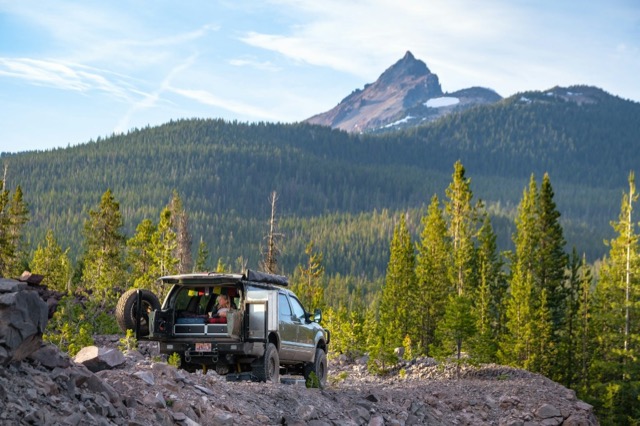
Yes — when you need full-size payload for slide-in campers, flatbeds, and heavy tow—not when you want nimble forest spurs or rock crawl.
F-250 and F-350 share one Super Duty chassis with factory payload in the four-thousand-pound class and diesel torque for expedition builds. Budget width, fuel stops, and CAT-scale culture; Tremor trims add trail hardware without making a dually a Wrangler.
Quick reality check
Heard this claim?
“If you are serious about overlanding you need a Super Duty.”
False for most buyers — true only when payload or camper mass demands it.
Forum wisdom confuses maximum capability with best fit. Super Duty wins when a slide-in camper, heavy flatbed, or multi-vehicle tow exceeds F-150 or Tacoma placards — not when you want tight forest spurs or fuel-efficient daily duty. Tremor adds trail tires and modes but does not shrink the truck. Buy Super Duty when the CAT scale says so; buy F-150 or mid-size when it does not.
Payload & trail loading
Editorial ballparks for Ford Super Duty (F-250 / F-350): empty-truck catalog numbers versus two common overlanding load profiles (two occupants assumed). This is the loaded-reality math factory spec sheets skip.
| Spec Category | Stock Factory Specs | With Mid-Weight Build (RTT + Fridge) | With Heavy Build (Armor + Winch) |
|---|---|---|---|
| Total Gear Weight Penalty | 0 lb | 550 lb | 900 lb |
| Remaining Safe Payload | 4,150 lb | 3,600 lb | 3,250 lb |
| Real Ground Clearance | 8.95″ | 8.2″ | 7.4″ |
| Free Cargo Space Volume | 91 cu ft | 45.5 cu ft | 27.3 cu ft |
Why this matters: Car dealerships list specs based on an empty truck. Once you add common adventure gear, your legal weight ceiling disappears fast. Always verify your specific door placard math before buying accessories.
Payload degradation
Estimates — verify on your door placard. Occupant weight included from Stage 1 build rows onward (300 lb editorial baseline for two adults).
Payload reality check: factory ~4,450 lb payload class is why buyers step up — wet campers, passengers, and gear still exceed GVWR when owners trust brochure math. CAT scale with full fluids and camp load before remote travel.
Off-road capability
Ford Super Duty (F-250 / F-350, 2017–present) is a heavy-duty body-on-frame truck for maximum payload, towing, and camper builds — part-time 4WD with low range on 4×4 models. Tremor trims add trail packaging on F-250; most overland Super Duties are diesel or gas work trucks with campers, not narrow-trail crawlers. It excels on graded access roads to remote camp with heavy builds — width, fuel, and clearance are the limits.
| Capability | This rig | Notes |
|---|---|---|
| 4WD system | Part-time 4WD (4×4 models) | Shift-on-the-fly electronic 4WD on modern trucks |
| Transfer case / low range | Yes — 4Lo on 4×4 | Torque-rich low range for heavy loads |
| Center differential | None (part-time) | 4Hi locks front and rear |
| Front locker | None factory | Tremor uses LSD + traction aids |
| Rear locker | None factory | Aftermarket available — uncommon on camper rigs |
| Axle layout | Solid front + solid rear (4×4) | F-350 DRW adds width — verify listing |
| Traction aids | Terrain modes (Tremor / FX4) | Hill descent and trailer sway on tow trims |
| Stock clearance | ~8.9 in (editorial) | Tremor lifts — still truck belly on rock |
| Factory skid protection | Partial — Tremor / FX4 | Plan full skids for off-pavement camper access |
Trail size
The widest common overland truck class — confident on graded BLM and forest mainlines, awkward on shelf roads and crowded trailheads. Length grows with crew cab and long bed; DRW F-350 is a parking event.
| Dimension | This rig | Notes |
|---|---|---|
| Width (body) | ~80–84 in | DRW dually rear far wider — trail and mirror reality |
| Wheelbase (crew cab) | ~164–176 in | Long bed adds more — camper planning critical |
| Length (overall) | ~250 in+ | Camper overhang adds more — know total length |
| Turning radius (approx.) | ~25 ft+ | 3-point turns common on tight spurs |
| Approach angle (Tremor) | ~31° | Stock lower — camper nose changes geometry |
| Departure angle | ~22° | Hitch, camper, and spare — scrape risk |
| Breakover angle (stock) | ~19° | Long wheelbase + low clearance — plan lines |
Shelf roads: Fine on open graded dirt and mainline forest roads with a spotter — tight shelf roads and switchbacks are the hard limit before 4WD hardware matters. Mid-size trucks and SUVs fit where Super Duty owners choose different routes.
Where it fits
Graded Forest Service / county dirt roads
ComfortableDefault access road rig — not the limiting case.
Narrow shelf roads & one-lane spurs
TightWidth and length — expect to spot and reverse.
Tight switchbacks & tree-lined spurs
TightOften a hard no with camper — choose routes deliberately.
Steep ledges & breakover humps (stock clearance)
TightLow clearance + long wheelbase — skids and belly scrapes.
Deep snow & mud (4Lo + tires)
FineWeight and torque help — size still punishes turning.
Engine & ownership
Highway miles, fuel stops, and shop visits matter as much as crawl hardware — especially on rigs you daily.
Engine
6.7L Power Stroke diesel dominates heavy tow and camper builds; 6.8L gas V8 and 7.3L gas options serve buyers wanting simpler fuel and lower upfront cost. Tremor pairs gas HO turbo on F-250 for trail-oriented trims.
Transmission
10-speed TorqShift automatic on modern Super Duty. Part-time 4WD with 4Lo; integrated trailer brake and tow haul modes on work trims. Diesel exhaust brake helps long grades with camper mass.
Fuel economy
City
12 mpg
Hwy
18 mpg
Combined
14 mpg
Diesel highway EPA estimates — camper and trailer mass hurt all MPG. Large tank helps range; fill stops still plan remote loops.
Fuel range estimate
Pick the kind of driving you're planning — tank capacity and MPG stay fixed from factory / EPA figures on this profile. Not a trip planner; verify on your own routes.
Steady cruise to the trailhead — stock highway MPG ballpark.
Estimated range · Pavement
~558 mi
- Tank
- 34 gal
- Usable
- 31 gal
- MPG used
- ~18
- Reserve
- 3 gal
On highway, a 34-gal tank (31 gal usable with 3 gal reserve) at ~18 MPG is about 558 mi of range.
Maintenance vibe: Super Duty work-truck culture means strong dealer diesel support — not cheap ownership. DEF, emissions, and turbo service on Power Stroke; gas V8 simplifies some headaches. Camper weight accelerates brake and tire wear.
Common failure points
Emissions / DEF system (diesel)
Modern diesel homework — quality DEF and regen awareness on long idle camp days.
Camper weight vs placard
Buyers overload GVWR with wet campers — CAT scale before you trust dealer brochure payload.
Steering and tire wear (heavy front axle)
Alignment and tire rotation matter with camper or plow mass up front.
Parking brake / hill hold (loaded)
Verify trailer and camper brake integration on steep camp access roads.
Width on trail (user error)
Not a defect — owners discover shelf roads the hard way. Route planning beats lockers.
Who this rig is for
Slide-in camper builder
Needs placard headroom F-150 cannot offer — accepts width and fuel tradeoffs.
Heavy tow expedition
Pulls adventure trailer or boat plus truck camper — diesel torque and frame stiffness matter.
Flatbed overland rig
Custom bed build for tools, water, and habitat — Super Duty frame as the canvas.
F-150 upsizer
CAT scale said mid-size is not enough — stepped up with eyes open about trail width.
Not a great fit if: You want tight technical trails, efficient daily commuting, or moderate payload bed-rack builds — F-150 or mid-size trucks fit better. Skip DRW for shelf-road overland fantasies.
Trim breakdown
XLT / Lariat 4×4 (gas or diesel)
~$48k–$70k new · builds vary widely
- Part-time 4WD + low range
- Camper / tow payload class
- Factory 35″ trail tires
- Narrow-trail nimble
Work-truck foundation — add tires, skids, and camper fitment homework.
Shop trim listingsF-250 Tremor
~$65k–$85k new
- 35″ tires + lift + trail modes
- Heavy payload vs F-150
- Mechanical lockers
- Fits tight shelf roads
Graded-dirt access with camper mass — still full-size++ everywhere.
Shop trim listingsF-350 DRW diesel (camper tow)
~$70k–$95k+ · camper extra
- Maximum tow & stability
- Power Stroke torque
- Trail width friendly
- Daily parking easy
Big camper and toy hauler duty — choose routes, not rock crawl.
Shop trim listingsYear & trim notes
2017+ aluminum Super Duty
Current gen platform — verify 10-speed and diesel emissions year-specific updates on used trucks.
F-250 vs F-350
F-350 for DRW and max tow; F-250 for most camper builds — compare GVWR on identical configs.
Tremor on F-250
Trail tires and modes — still a full-size++ truck with camper limitations.
Gas vs diesel fork
Diesel for tow and range torque; gas for simpler ownership and lower entry on used market.
Long bed + crew cab
Camper fitment default — total length affects every camp loop and ferry.
Super Duty vs F-150
Step up when placard math demands — not for tighter trails or better MPG.
Build path
Get capable
- All-terrain tires (35″ on Tremor or add)~$1,600
- Skid plates (full belly coverage)~$900
- Recovery kit (heavy-duty strap, shackles)~$350
- Satellite messenger (InReach Mini)~$350
~80 lb added — clearance is the story, not just tires.
Sleep & carry
- Slide-in camper (dry weight varies)~$8k–$25k
- Camper tie-downs + stable load~$500
- Aux fuel or water (if needed)~$400
- 12V fridge + camper electrical~$1,200
~1,200 lb stage delta is illustrative — wet camper weight dominates. Weigh wet.
Expedition ready
- Front winch bumper (steel)~$3,200
- Dual battery / solar (camper)~$1,500
- Auxiliary air or load-leveling~$800
- Trail comms + GMRS radio~$250
~600 lb stage delta on top of camper — factory ~4,450 lb payload helps but is not infinite.
Off-road glossary
Plain-language definitions for the capability table — what each term means and why it matters on trail.
GVWR / payload
- What it is
- Gross vehicle weight rating minus curb weight equals payload — camper dry weight is not the whole story.
- Why it matters
- Super Duty shopping is placard math first — badge second.
Power Stroke 6.7L
- What it is
- Ford's heavy-duty diesel V8 — high torque for tow and camper builds.
- Why it matters
- Default engine for expedition tow — adds DEF and diesel service rhythm.
Super Duty Tremor
- What it is
- Trail-oriented F-250 package with 35″ tires, lift, and terrain modes.
- Why it matters
- Adds graded-dirt access hardware — does not shrink the truck.
DRW (dually)
- What it is
- Dual rear wheels on F-350 for maximum tow and stability.
- Why it matters
- Trail width penalty — rare choice for technical overland routes.
FX4 Off-Road package
- What it is
- Skids, shocks, and 4×4 branding on work trims — not Tremor-level tires.
- Why it matters
- Better than plain 4×4 for dirt access — still verify tires and clearance.
Slide-in camper
- What it is
- Truck-bed camper loading onto rails — Super Duty sweet spot when payload allows.
- Why it matters
- Why many buyers step up from F-150 — verify fitment, center of gravity, and tie-downs.
Common questions
- Is the Ford Super Duty good for overlanding?
- Yes when you need heavy payload for campers, flatbeds, or tow — not when you want nimble forest spurs. Tremor helps graded dirt access; width and fuel are the tradeoffs.
- F-250 vs F-150 for overlanding?
- F-150 for most dirt-to-camp bed builds and daily size. Super Duty when camper, flatbed, or tow mass exceeds F-150 placards — see our F-150 profile and compare.
- Do I need diesel?
- Diesel helps heavy tow and long-range torque; gas works for lighter camper builds with simpler service. Match engine to actual weight, not forum flex.
- Is Tremor enough trail hardware?
- For graded access roads with 35″ tires — yes. For rock crawl and narrow shelf roads — wrong tool regardless of Tremor.
- Can I daily a Super Duty overlander?
- People do — expect parking pain, stiff empty ride, and fuel cost. Many owners keep a smaller daily and reserve Super Duty for trip weeks.
- Slide-in camper on F-250?
- Classic use case — verify dry and wet weight against placard, tie-downs, and center of gravity before remote travel.
Honest assessment
Editorial opinions from our crew — not instrumented test results or Ford's official position. Your mileage, trails, and budget may differ.
Strengths
- Massive payload & towing — Factory ~4,450 lb payload class and diesel tow headroom — slide-in campers, flatbeds, and toy haulers start here when midsize math fails.
- F-250 / F-350 one chassis — Single Super Duty profile covers both — spec GVWR, axle, and bed to your camper or build instead of badge shopping alone.
- Power Stroke diesel option — 6.7L diesel torque for heavy tow and expedition fuel range — gas Power Stroke alternatives exist for buyers who want simpler service.
- Tremor trail package (F-250) — Factory 35″ tires, lift, and trail modes on Super Duty Tremor — rare full-size trail hardware for graded dirt access.
- Stable camper platform — Frame stiffness and rear axle choices matter for big builds — Super Duty is the default when a Tacoma or F-150 placard says no.
Drawbacks
- Full-size++ width — Wider than F-150 — narrow shelf roads and trailhead parking punish Super Duty daily.
- Stock clearance ~8.9 in — Low for a trail rig — skids and line choice mandatory; not a rock crawler stock.
- Fuel cost & stops — Diesel and gas V8 thirst on long remote loops — plan range; aux tanks add weight.
- Ride quality (empty) — Stiff when unloaded — camper or bed weight changes the equation; empty commute can feel harsh.
- Configuration complexity — DRW, axle ratings, and camper packages overwhelm shoppers — verify GVWR and payload on the exact build sheet.
- Not a nimble trail toy — Expedition and tow platform — technical spurs favor mid-size or SWB SUVs.
Read next




 Index
IndexReal community builds
No one has shared a real Ford Super Duty (F-250 / F-350) build on this platform yet.
Already have a Ford Super Duty (F-250 / F-350)?