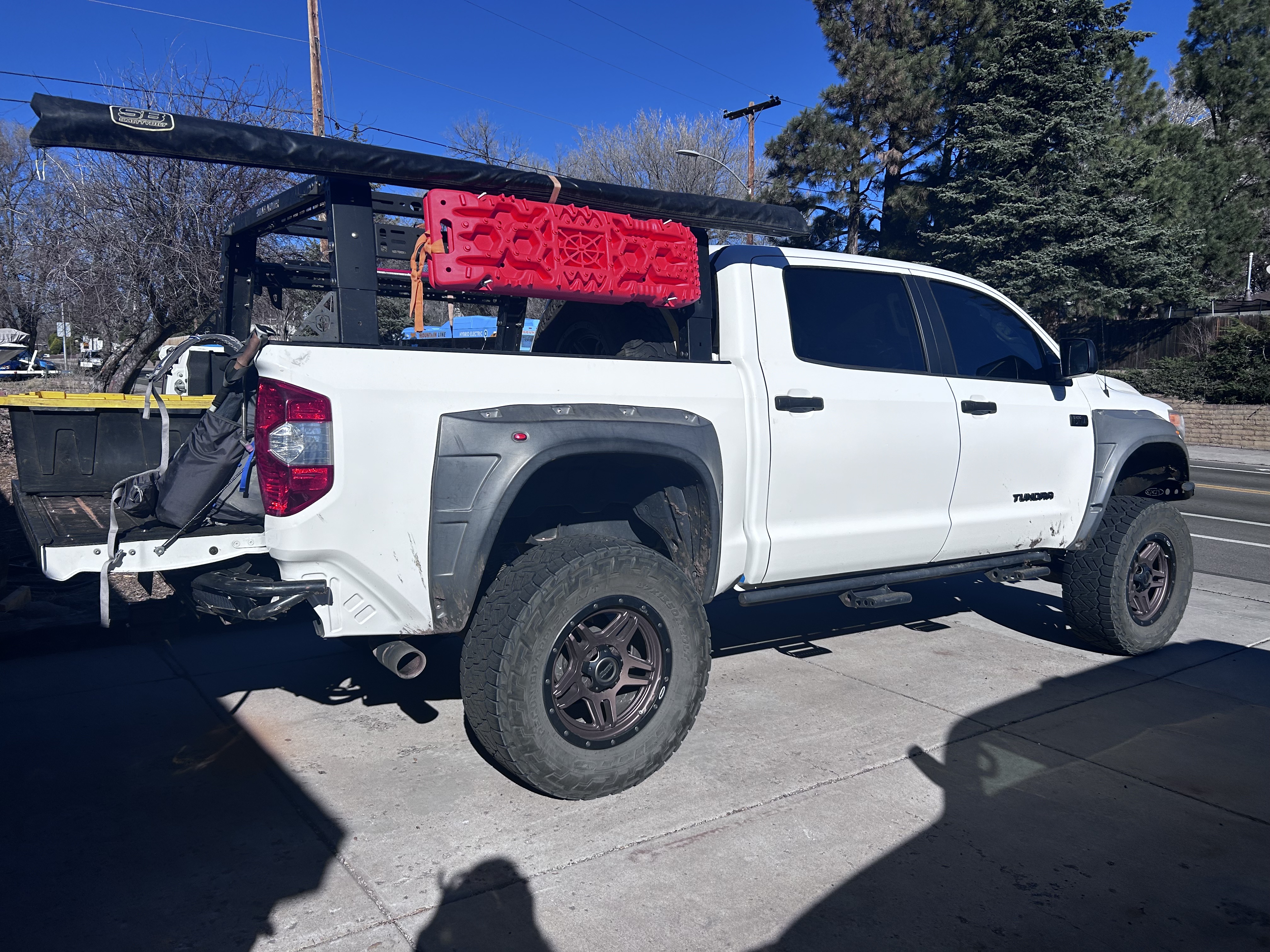
Toyota
Toyota Tundra (2nd gen, 2007–2021)
$18k – $52k typical used · TRD trims vary. Specs below cite factory payload, clearance, and cargo where available; remaining-payload after occupants and gear is our editorial load model. Trims vary — verify on the sticker, placard, and with Toyota before you load up or buy.
Compare note
Production ended 2021 — used and import compare only. 3rd gen replaced this platform in North America. Toyota Tundra (3rd gen, 2022+) →
- Reliability vibe
- 9/10
- Ground clearance
- 10.6″ rep.
- Payload (approx.)
- 1,720 lb rep.
- Cargo (approx.)
- 56 cu ft

Is the 2nd gen Tundra good for overlanding?
Yes — the smart-money full-size Toyota when frame metal is honest and you need bed length and factory ~1,720 lb payload. It is not a narrow-trail or fuel-sipper mid-size.
Part-time 4WD, low range, coil-spring rear, and NA 5.7L V8 simplicity handle graded dirt and long highway legs to camp well. Budget full-size width on spurs, rust inspection in salt states, and TRD trim payload penalties before the RTT goes on.
Quick reality check
Heard this claim?
“A used 2nd gen Tundra is the smart overland buy over any new midsize truck.”
Often true on payload and price — not automatic if you need narrow trails or modern chassis refinement.
2nd gen Tundra wins factory ~1,720 lb payload, full-size bed length, and NA V8 simplicity against Tacoma-class trucks — especially when used pricing lands well below new 4th gen MSRP. Midsize still wins shelf-road width, fuel economy, and parking at crowded trailheads. TRD Off-Road and Pro close much of the factory trail gap vs an SR5 Tacoma with tires — they do not shrink the truck. Shop 2nd gen Tundra when CAT scale math and bed builds matter; shop midsize when spurs and daily size dominate.
Payload & trail loading
Editorial ballparks for Toyota Tundra (2nd gen, 2007–2021): empty-truck catalog numbers versus two common overlanding load profiles (two occupants assumed). This is the loaded-reality math factory spec sheets skip.
| Spec Category | Stock Factory Specs | With Mid-Weight Build (RTT + Fridge) | With Heavy Build (Armor + Winch) |
|---|---|---|---|
| Total Gear Weight Penalty | 0 lb | 550 lb | 900 lb |
| Remaining Safe Payload | 1,420 lb | 870 lb | 520 lb |
| Real Ground Clearance | 10.65″ | 9.9″ | 9.1″ |
| Free Cargo Space Volume | 56 cu ft | 28 cu ft | 16.8 cu ft |
Why this matters: Car dealerships list specs based on an empty truck. Once you add common adventure gear, your legal weight ceiling disappears fast. Always verify your specific door placard math before buying accessories.
Payload degradation
Estimates — verify on your door placard. Occupant weight included from Stage 1 build rows onward (300 lb editorial baseline for two adults).
Payload reality check: factory ~1,720 lb payload helps vs midsize trucks — TRD Pro and heavy CrewMax builds shrink margin fast. Stage 2–3 plus passengers and fuel still demands a CAT scale before the long loop.
Off-road capability
The 2nd gen Toyota Tundra (2007–2021) is a coil-spring full-size overland truck — part-time 4WD with low range, strong factory payload on non-Pro builds, and TRD trail trims with Bilstein or Fox hardware. The 5.7L V8 is the defining powertrain. It excels on graded forest roads, BLM two-tracks, and long highway legs to dispersed camp — width and wheelbase are the trail limits, not lack of Toyota truck credibility.
| Capability | This rig | Notes |
|---|---|---|
| 4WD system | Part-time 4WD (4×4 models) | Electronic shift-on-the-fly on later years |
| Transfer case / low range | Yes — 4Lo on 4×4 | Two-speed transfer case — verify 4×4 on sticker |
| Center differential | None (part-time) | 4Hi locks front and rear — not a center LSD |
| Front locker | None factory | A-TRAC brake traction only |
| Rear locker | TRD Off-Road (select years/configs) | Verify e-lock or mechanical locker on used listing |
| Axle layout | IFS front + solid coil rear | Coil-spring rear — not leaf like older Tacoma |
| Traction aids | A-TRAC + Crawl Control (TRD) | Multi-Terrain Select on later TRD trims |
| Stock clearance | ~10.6 in (editorial) | TRD trims similar — tires change effective height |
| Factory skid protection | Partial — TRD better | Plan skids for rocky routes on any trim |
Trail size
Full-size width and long CrewMax wheelbase — confident on graded BLM roads, present on narrow shelf spurs. TRD Pro track feels trail-ready; parking and camp loops favor mid-size trucks.
| Dimension | This rig | Notes |
|---|---|---|
| Width (body) | ~79.9 in | Full-size — mirrors add more on trail |
| Wheelbase (CrewMax) | ~145.7 in | Double Cab shorter — verify cab |
| Length (CrewMax 5.5′ bed) | ~228 in | 8′ bed adds length — camp and trail feel |
| Turning radius (approx.) | ~22 ft | Plan 3-point turns on tight spurs |
| Approach angle (TRD Off-Road) | ~32° | SR5 lower — bumper and tire dependent |
| Departure angle (TRD Off-Road) | ~23° | Hitch and spare — watch ledge exits |
| Breakover angle (stock) | ~22° | Long wheelbase — line choice on humps |
Shelf roads: Comfortable on maintained forest roads and open BLM — the 2nd gen Tundra sweet spot. Narrow shelf roads and crowded trailheads punish full-size length; mid-size Tacoma owners park easier. TRD hardware helps traction, not width.
Where it fits
Graded Forest Service / county dirt roads
ComfortableDefault Tundra territory — TRD Bilstein helps on washboard.
Narrow shelf roads & one-lane spurs
TightFull-size width — spotter and backup planning.
Tight switchbacks & tree-lined spurs
Tight145″ wheelbase shows up — not a mid-size.
Steep ledges & breakover humps (stock clearance)
Fine~10.6 in clearance plus TRD angles — skids still matter.
Deep snow & mud (4Lo + rear locker)
ComfortableTRD rear locker when equipped — V8 torque helps slow crawl.
Engine & ownership
Highway miles, fuel stops, and shop visits matter as much as crawl hardware — especially on rigs you daily.
Engine
US 2nd gen Tundra centers on the 5.7L 3UR-FE V8 (~381 hp) — naturally aspirated torque for tow and crawl without turbo heat management. Early years offered 4.7L and 4.0L V6; most overland shopping targets the 5.7L CrewMax and TRD builds.
Transmission
Six-speed automatic on later 5.7L years; five-speed on early builds. Part-time 4WD with electronic 4Lo; TRD Off-Road and Pro add crawl control, multi-terrain modes, and rear locker availability depending on year and config.
Fuel economy
City
13 mpg
Hwy
17 mpg
Combined
14 mpg
EPA estimates for 5.7L — large 38 gal tank helps remote range despite thirsty MPG. RTT and bed rack hurt highway efficiency.
Fuel range estimate
Pick the kind of driving you're planning — tank capacity and MPG stay fixed from factory / EPA figures on this profile. Not a trip planner; verify on your own routes.
Steady cruise to the trailhead — stock highway MPG ballpark.
Estimated range · Pavement
~595 mi
- Tank
- 38 gal
- Usable
- 35 gal
- MPG used
- ~17
- Reserve
- 3 gal
On highway, a 38-gal tank (35 gal usable with 3 gal reserve) at ~17 MPG is about 595 mi of range.
Maintenance vibe: 5.7L V8 carries strong Toyota truck service folklore — not maintenance-free, but predictable compared with first-run turbo trucks. Frame rust inspection matters more than engine anxiety on snow-belt used buys. Timing chain and underbody corrosion are shopping homework items.
Common failure points
Frame rust (snow-belt used market)
Underbody and frame inspection before purchase — southern trucks command premium for a reason.
Secondary air injection system (some years)
Emissions hardware chatter on high-mileage 5.7L — budget diagnosis on older listings.
TRD payload haircut
Not a defect — Fox/Bilstein and trail trim weight shrink margin vs SR5. CAT scale culture applies.
Bed rack wind noise & MPG
Aerodynamics hit on highway — plan fuel stops with RTT or tall topper despite big tank.
Rear locker config confusion
Verify TRD Off-Road locker presence by year — not every used Pro/Off-Road listing is equal.
Who this rig is for
Used full-size value hunter
Wants Toyota truck payload without new-truck MSRP — accepts older infotainment and frame inspection homework.
5.7L NA simplicity buyer
Prefers naturally aspirated V8 service rhythm over turbo/hybrid complexity on 3rd gen.
Tacoma upsizer
Outgrew midsize placard math for RTT, drawers, or family gear — debating width tradeoffs openly.
TRD Off-Road used shopper
Targets Bilstein, crawl control, and locker configs in the $18k–$52k used band.
Not a great fit if: You need narrow-trail nimbleness, maximum fuel economy, or the newest interior/tech — midsize Tacoma or 3rd gen Tundra may fit better. Skip snow-belt frames without underbody inspection.
Trim breakdown
SR5 / Limited 4×4 (5.7L)
~$18k–$35k used · mileage varies
- Part-time 4WD + low range
- Factory trail tires / Fox shocks
- 5.7L NA V8 simplicity
- Strong payload vs TRD Pro
The rational used build donor — add A/T tires, skids, and bed rack.
Shop trim listingsTundra TRD Off-Road
~$28k–$45k used · verify locker
- Bilstein + crawl control
- Rear locker (select configs)
- Multi-Terrain Select
- Max payload in lineup
Used overland sweet spot — factory trail tune without Pro payload penalty.
Shop trim listingsTundra TRD Pro
~$35k–$52k used · holds value
- Fox internal bypass shocks
- TRD Pro skid package
- Desert-runner trail tune
- RTT + winch payload headroom
Buy for factory Fox trail hardware — weigh before heavy camper builds.
Shop trim listingsYear & trim notes
2007–2013 early 2nd gen
Five-speed auto and earlier infotainment — verify 5.7L and locker config on used listings.
2014–2021 mature 5.7L era
Six-speed and refreshed front end — sweet spot for used TRD Off-Road and Pro shopping.
TRD Off-Road vs Pro
Off-Road for Bilstein and locker value; Pro for Fox shocks and trail branding — both shrink payload vs SR5.
CrewMax vs Double Cab
CrewMax dominates family overland; Double Cab saves length for solo builds.
5.5′ vs 8′ bed
5.5′ common on CrewMax — drawer and RTT fitment still strong; 8′ for max cargo length.
2nd gen Tundra vs midsize Tacoma
Full-size wins payload, bed, and V8 tow; midsize wins spurs, fuel, and parking — see our compare.
Build path
Get capable
- All-terrain tires (275/65R18 or 33″)~$1,200
- Skid plates (engine + transfer case)~$700
- Recovery kit (strap, shackles, boards)~$300
- Satellite messenger (InReach Mini)~$350
~60 lb added — TRD trims may skip suspension stage 1.
Sleep & carry
- Bed rack or low-profile topper~$1,400
- Rooftop tent (bed rack mounted)~$1,400
- 12V fridge (BougeRV or Dometic)~$500
- Bed drawer system~$1,200
~420 lb stage delta (~480 lb cumulative). Full-size bed shines here.
Expedition ready
- Front bumper + winch~$2,800
- Dual battery (LiFePO4 aux)~$700
- Water storage (30–40 L)~$200
- Camper shell or wedge (optional)~$3,500
~450 lb stage delta (~930 lb cumulative). Factory ~1,720 lb payload — weigh before remote trips.
Off-road glossary
Plain-language definitions for the capability table — what each term means and why it matters on trail.
3UR-FE 5.7L V8
- What it is
- Toyota's naturally aspirated full-size truck V8 used across 2nd gen Tundra — shared lineage with Lexus truck/SUV applications.
- Why it matters
- The powertrain reason to shop 2nd gen — NA simplicity vs 3rd gen turbo/hybrid stack.
TRD Off-Road
- What it is
- Trail trim with Bilstein shocks, crawl control, multi-terrain select, and rear locker on select configs.
- Why it matters
- The value overland trim to hunt used — better trail hardware than SR5 without Pro pricing.
TRD Pro
- What it is
- Top trail trim with Fox internal bypass shocks, TRD skid package, and desert-runner attitude.
- Why it matters
- Factory trail suspension — trades payload for travel; verify placard before RTT + winch math.
Crawl Control
- What it is
- Low-speed crawl managing throttle and brakes on loose terrain — Toyota's trail-assist feature.
- Why it matters
- Helpful on descents — not a locker substitute on crossed-up rock.
Coil-spring rear
- What it is
- Solid rear axle with coil springs — standard on 2nd gen Tundra vs leaf on many Tacomas.
- Why it matters
- Better ride and articulation than leaf midsize — full-size width unchanged.
Part-time 4WD
- What it is
- Rear-wheel drive on pavement until you shift into 4Hi or 4Lo.
- Why it matters
- Better highway efficiency than full-time — avoid dry-pavement 4Lo binding.
Common questions
- Is the 2nd gen Tundra good for overlanding?
- Yes for full-size dirt-to-camp — TRD Off-Road or a sensible 4×4 with tires and rack is the common path. Budget width on narrow trails, frame rust on used shopping, and placard math on Pro builds.
- TRD Off-Road vs Pro on 2nd gen?
- Off-Road for Bilstein, crawl stack, and better payload balance. Pro for Fox shocks and trail branding — verify locker and placard on the exact truck.
- 2nd gen Tundra vs Tacoma / midsize?
- Tundra wins payload, bed length, and 5.7L tow simplicity; Tacoma wins tight trails, fuel economy, and mid-size parking. See our full compare.
- Should I buy 2nd gen used or 3rd gen new?
- 2nd gen when budget and NA V8 simplicity matter; 3rd gen when you want modern interior, turbo/hybrid efficiency, and higher factory payload — production ended 2021 on 2nd gen.
- Do I need full-size for a rooftop tent?
- No — but 2nd gen Tundra gives more payload margin once rack, tent, and passengers load up. Verify roof dynamic load and placard.
- Is a 2nd gen Tundra too big for overlanding?
- Too big for tight technical trails — not too big for graded dirt to dispersed camp. Match size to routes you actually drive.
- Frame rust on used Tundras?
- Real shopping homework in salt states — inspect frame, bed bolts, and underbody before you trust listing photos.
Honest assessment
Editorial opinions from our crew — not instrumented test results or Toyota's official position. Your mileage, trails, and budget may differ.
Strengths
- 5.7L V8 simplicity — Naturally aspirated 3UR-FE torque without turbo homework — proven powertrain with strong used-market confidence and straightforward service rhythm.
- Factory payload headroom — Factory ~1,720 lb payload beats midsize trucks for RTT racks, drawers, and family gear — TRD trims trade a little margin for suspension travel; verify your door sticker.
- TRD Off-Road / Pro trail trims — Factory Bilstein tune, crawl control, and trail hardware on the trims worth hunting — Pro adds Fox shocks on later years without starting from a blank SR5.
- Coil-spring rear ride — Full-size bed utility with coil rear suspension — better empty-bed composure than leaf-spring midsize trucks on long highway legs to camp.
- Used-market value window — Production ended 2021 — editorial $18k–$52k typical used opens full-size Toyota payload without new-truck ADM on a 3rd gen or 4th gen Tacoma.
Drawbacks
- Full-size width on spurs — ~80-inch body width shows up on narrow forest roads — Tacoma-sized trucks fit where Tundra owners spot each other.
- Frame rust audits (snow belt) — Used shopping in salt states demands underbody inspection — not every listing is a southern rust-free unicorn.
- TRD trims eat payload — Fox/Bilstein and trail hardware add weight — Pro and Off-Road builds shrink placard margin vs a plain CrewMax SR5.
- 5.7L fuel thirst — Large tank helps range — MPG still trails midsize trucks and 3rd gen turbo/hybrid Tundra on pavement.
- Long wheelbase (CrewMax) — ~145″ wheelbase on popular configs — switchbacks and camp parking need planning vs mid-size.
- Aging infotainment era — Pre-2020 interiors feel dated vs 3rd gen — acceptable for dirt-to-camp, not flagship tech.
Read next




 Index
Index